Latest Posts

Bruce Johnston

O

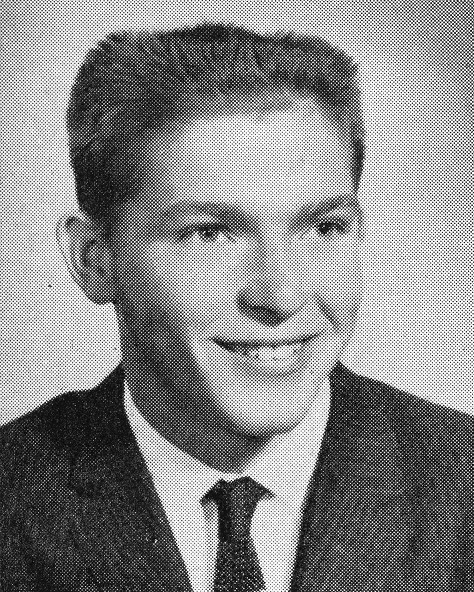
n June 27, 1959, future Beach Boy Bruce Johnston turned seventeen years old and also graduated from high school (a year early as Bruce had skipped ahead a year in the fourth grade!).

Bruce, originally named Benjamin Baldwin, was born June 27, 1942, in Peoria, Illinois.  His unwed mother from Madison, Georgia, gave birth to Bruce in the Florence Crittenton Home for unwed mothers and, three months later, he was adopted by William and Irene Johnston from Chicago. Bruce’s “new” father was senior Vice-President of the Chicago based Walgreens Drug Store chain. The Johnstons had two older daughters, Bette Jean and Joy Rene.

In September 1946, the Owl Rexall Drug Company began building their new national headquarters in Los Angeles (located at Beverly and La Cienega Boulevards and it included a Rexall drug super store which Life magazine called “the world’s biggest drugstore”).  In 1946 William Johnston accepted the position of president of the Owl Rexall Drug Company.  He moved his family to Santa Monica, California, where he supervised the building of Rexall’s Los Angles national corporate headquarters.  As a young boy, Bruce attended private schools and studied classical piano.

In September 1956 Bruce enrolled at University High School in West Los Angeles where, coincidentally, he was in school with Jan & Dean.  Ironically, had he attended Susan Miller Dorsey High, which served Baldwin Hills, he may have met a sophomore there named Michael Love.

In 1957, Bruce helped form the Sleepwalkers, a musical combo that included fellow Uni High students Sam (“Sandy”) Nelson, Dave Shostac, and Phil Spector.  Another student, Kim Fowley, managed them and arranged some local gigs.  “We’d travel one hundred miles for thirty dollars between us, which mostly went on gas,” recalled Johnston.  “We’d have a ball, but we never cut a record as a group.  It was just a fun thing.”

Another musical group at Uni High, a year or two ahead of them, was the Barons which included Jan Berry, Arnie Ginsburg, and Dean Torrence.  There was a lot of cross-pollinating in those days and Bruce played with many of the musicians blossoming onto the LA music scene.  The Sleepwalkers evolved into Kip Tyler and the Flips which Fowley told writer Steve Propes were “a bad version of Gene Vincent and the Blue Caps.”  Steve Douglas, who became an ace studio sax man, played with the Flips.  In addition to being a skilled keyboard player, Johnston showed talent as an arranger and songwriter.  “In the 1950s, people wanted to be in bands or be movie stars, wanted people to like them, appeal to girls or guys, silly stuff,” Johnston recalled.

On February 1, 1958, Johnston, Nelson, and Shostac, visited record impresario John Dolphin at his office at 1252 South Berendo Street in Hollywood to pitch him a demo of a song written by Fowley.  Although they were only sophomores in high school, they were about to get a college education in the music business.  “We made a demo at Western,” Johnston explained.  “We were asked by a guy there to bring the demo to his office.  When we got to his office, it was locked.”  Dolphin owned Dolphin’s of Hollywood record store in predominantly black South Central LA.  Errol Garner, one of Bruce’s piano idols, had recorded for Dolphin’s record labels.

As they waited outside, they struck up a conversation with Percy Ivy, a twenty-six-year-old singer, there to either reclaim four of his demos or the $250 per song Dolphin allegedly promised him.  “There was another guy waiting outside,” Johnston continued.  “So, I went to a pay phone and called the guy inside his office to come and open the door.  He did and the other guy went in with us.”  Once inside the small office, Dolphin and Ivy argued while Bruce and his friends looked on.  The argument became heated and Ivy, who later claimed Dolphin pulled a switchblade knife on him, fired five or six shots at close range with a 32-caliber Italian automatic handgun.  Dolphin fell dead on top of a small space heater.  Shostac was grazed in the leg by a ricocheting bullet and Nelson, still carrying a soft drink, ran to get help.  When Nelson returned to the office with the police, Johnston was reportedly negotiating a record deal with Ivy for when he got released from prison.  The police booked Ivy on suspicion of murder.  “I didn’t go down there to shoot him,” he told police.  “I just wanted my songs back.”

In summer 1958, Bruce got a call from his old friend Phil Spector.  “One day, Phil called me to ask if I’d play piano on a session.  I already had a date, and had to turn him down.  The record turned out to be ‘To Know Him Is to Love Him,’ and it wound up being a million seller.  But I wasn’t discouraged, I carried on.”
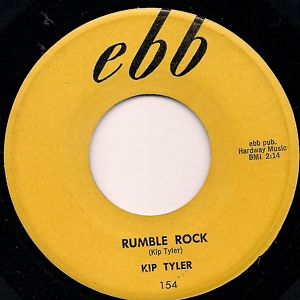
Rumble RockIn November 1958, as a high school junior, Bruce made his first appearance on vinyl playing keyboards on Kip Tyler’s “She’s My Witch” (b/w “Rumble Rock,” Ebb 154).  “You have to remember, here I am a sixteen-year-old guy and, all of a sudden, I’m in this little band and I’m playing little rock and roll shows on weekends, backing people like the Everly Brothers and watching the Champs come out and do ‘Tequila’ and all that stuff.  Oh, and Ritchie Valens.  We used to back Ritchie all the time.  We used to rehearse with him.  He’d show up with a three-quarter sized guitar and a little amp and then we’d rehearse three or four songs and go out to the Pasadena Civic Auditorium or Long Beach Civic Auditorium, because they didn’t allow rock and roll shows within the LA city limits in 1958.  It was very exciting time because you would have people like the Everly Brothers star in the show and then you’d have the local or one-hit wonder kind of acts.  It was great for a kid.”

In spring 1959, Kip Tyler planned to release a Johnston-Fowley composition called “Say What’s in Your Heart” as a follow-up single.  Johnston lobbied for the band to be called Kip Tyler and the Sleepwalkers, and felt double-crossed when Tyler chose the name Kip Tyler and the Jamborees instead.  Tyler and Fowley didn’t get along, and Johnston took Fowley with him when he left Tyler to form a production company called Modern Age Enterprises.

In May 1959, Kim Fowley produced a session for the Renegades, a makeshift studio combo that included Bruce Johnston, Sandy Nelson, Richie Podolor, and Nick Venet.  They recorded Venet’s “Charge” (b/w “Geronimo,” American International 537) for the soundtrack of American International Pictures’ The Ghost of Dragstrip Hollow.

In early summer 1959, Johnston recorded his own “Take This Pearl” and “I Saw Her First,” co-written with Jerry Cooper, another friend from high school.  The musicians at the session were Shostac on sax, Nelson on drums, Harper Cosby on bass, Mike Deasy on guitar, and Johnston on piano.  Johnston planned to release the record as by Bruce and Jerry and the Sleepwalkers.  He told Fowley that if Tyler performed as the Sleepwalkers, he would sue him.  Meanwhile, Fowley left American International and began working as a food runner and assistant at Arwin Records, owned by Doris Day and her husband, Marty Melcher.  Although Johnston hoped “Take This Pearl” would be picked up by Capitol, Fowley arranged for it to be released on Arwin as by Bruce and Jerry in May 1959 (b/w “I Saw Her First,” Arwin 1003).  “Take This Pearl” received some local radio play, but didn’t chart nationally.  As he finished his junior year at Uni High, Johnston was dating a classmate named Gina Maschio, the daughter of singer/actress Constance Moore, who played Wilma Deering, the only female role in the 1939 movie serial Buck Rogers.  Johnston confided to Fowley that Gina had spent most of her life in private school and knew “all the social kids we do and thinks of them as we do.”

In August, Bruce helped Sandy Nelson with his breakthrough hit “Teen Beat.”  “I got my dunka chica dunka sound,” Nelson confided, “by imitating somebody else.  Jan, Dean, and Arnie Ginsburg, who I knew from University High, we’d go to the New Follies Burlesque in downtown LA to see the strip shows.  But I was looking at the pit drummer more than the naked girl.  This old drummer, a white guy, had a few ‘Caravan’-like beats I incorporated into an idea I wanted to do called ‘Teen Beat.’  I made a demo in spring of ’59 and took it to disc jockey Art Laboe, and we re-recorded it for Art’s Original Sound label at Ritchie Podolor’s American studio on Sunset in Hollywood with Ritchie on guitar and Bruce Johnston, an ex-classmate of mine, on piano.”  The writing credit went to Nelson and Laboe, using his real last name, Egnoian.  Johnston recalled, “I played on it and, by virtue of how we put it together, I qualify along with Richie Podolor as the writer with Sandy Nelson.  But it didn’t turn out that way because we were too green to ask for a writing credit.”  But Nelson wasn’t savvy enough to form his own music publishing company, and Laboe registered the copyright to his own Drive-In Music, a nod to the afternoon radio show he broadcast live from Scrivener’s Drive-In.  Cash Box selected “Teen Beat” (b/w “Big Jump,” Original Sound 05) as a Sure Shot September 5 and it charted for the next fifteen weeks, peaking at #4.

By fall 1959, Johnston was working as a producer for Bob Keane’s Del-Fi and Donna labels.  “We were fortunate enough to find Bruce Johnston at the early age of seventeen when he walked into my office,” recalled Keane.  “He displayed incredible talent and a never-ending enthusiasm for music.  Thanks to his musicianship, production, and A&R work, he helped shape the Del-Fi sound for the early sixties.”
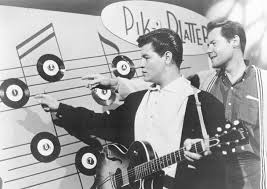
Richie Valens and Bob Keane

Ritchie Valens and Bob Keane

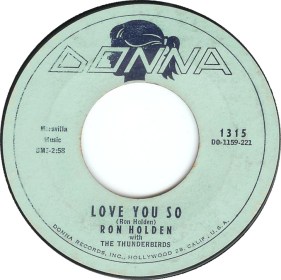
While visiting a new Seattle distributor in fall 1959, Keane bought the masters to “Love You So” and “My Babe,” the top two local songs by an eighteen-year-old black singer named Ron Holden.  At six-foot two inches and two hundred and ten pounds, Holden was a street-wise amateur boxer serving a ninety day jail sentence for a minor infraction.  Keane released the songs on his Donna Records (1315) while Holden was still incarcerated.  Unhappy with the promotion done by his distributor, Record Merchandiser, Keane switched to A&A Distributors who got KRKD disc jockey Dick “Huggy Boy” Hugg to plug the record.

By May 1960, Holden had the #5 record in Cash Box.  With the single’s success, Keane asked Johnston to assemble a full-length album.  Bruce arranged, produced, and helped write nine of eleven songs on Holden’s Love You So album in August 1960.  “Let’s just say I put his album together,” Johnston recalled.  “I’d rather not explain it other than I put the whole album together.  With the Ron Holden project, I was kind of a trainee getting a chance to get my songs recorded.”

“My early years as a musician in Los Angeles as arranger, producer, artist, and A&R man at Del-Fi was a time of innocence, talent, and opportunity,” recalled Johnston.  “It was like going to school by accident. Bruce - Ron Holden record I was cutting my teeth on all these different styles of music.  I can’t say enough about how much both Sandy Nelson and Kim Fowley contributed to my growth and progress in the music business.  They introduced me to many people and inspired me to continue soaking up all this incredible musical culture that was happening at the time.  Veteran session pianist Larry Knechtel spent four hours back in 1958 teaching me piano.  That was a big turnaround for me.  My early heroes of the keyboard were Errol Garner and Ernie Freeman.  I also learned a lot from watching Bob Keane work.  He was an incredible musician, very talented.  It was an amazing time.  In Los Angeles in the early sixties it was all about music.  Cultural barriers didn’t matter.  I went all over town to watch what was happening.”
In summer 1960, Kim Fowley worked as a food runner and programming assistant for Alan Freed at KDAY.  Meanwhile, Johnston recorded demos for Herb Alpert for ten dollars a song and opened some shows for Brenda Lee.  He wrote, co-wrote, arranged, or produced eight singles for the Del-Fi and Donna labels, including Ron Holden’s follow-up single “Gee, But I’m Lonesome” (b/w “Susie Jane,” Donna 1324).  “The intro with the piano rolls was my way of emulating the harp on the beginning of Doris Day’s “Secret Love” which had that big, flowing beginning,” recalled Johnston.  “I have very fond recollections about the experience of working with Ron.  He was incredible.  I once took him surfing in San Diego.  He was the greatest guy and a terrific talent.”

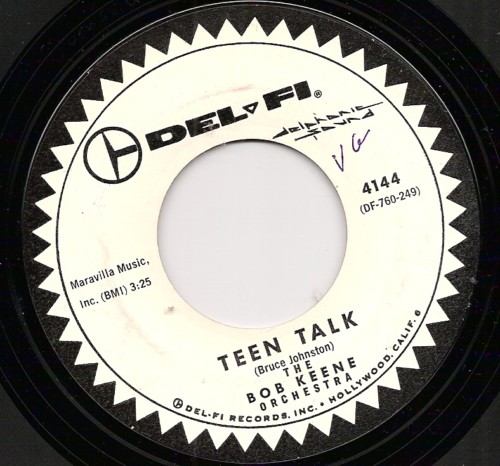
In July 1960, Johnston collaborated with Keene on “The Toughest Theme” (b/w “Teen Talk,” Del-Fi 4144), a mixture of twelve-bar blues and Big Band, recorded by the Bob Keene Orchestra [note:  Keene sometimes spelled his name Keane.]  When Keene signed the Pharaos, Richard (“Louie, Louie”) Berry’s back-up singers, he assigned Johnston to work with them.  Teen TalkThe Pharaos’ vocalist Godoy Colbert sang Johnston’s “The Tender Touch” with Berry providing background vocals.  Johnston and Fowley penned the flip (“Heads Up, High Hopes Over You,” Donna 1327).  Despite an appearance on Wink Martindale’s Dance Party television show, the Pharaos failed to chart.  Next up was Ron Holden’s third single, “Everything’s Gonna Be Alright” (b/w “True Love Can Be,” Donna 1328), two album cuts Johnston co-wrote with Holden.
In September 1960, Johnston enrolled as a freshman at UCLA and co-wrote “I’m Coming Home” with Janice Rado.  “I remember we recorded that one at Gold Star,” Johnston recalled.  “Janice was a friend of my sister’s and I brought her to the attention of Del-Fi.”  “I’m Coming Home” (b/w “This Feeling”) by Janice Rado and the Sequins was released on Edsel 782, a subsidiary of Del-Fi, but failed to chart.  Mel Carter recorded “I’m Coming Home” for his debut on Arwin Records (Arwin 23) that also failed to chart.

In October 1960, Johnston wrote and played piano on “Rock ‘n’ Roll Honky Tonk” (b/w “The Bend,” Donna 1329) by Studs Donegan and the Mob.  That November, he placed two songs as B sides.  “Your Line Is Busy,” another Johnston-Holden album cut, was paired with Holden’s seasonal effort “Who Says There Ain’t No Santa Claus” (Donna 1331).  “Don’t Put Me Down,” co-written with disc jockey Jim Randolph, was the B side to Millard Woods’ “(I’m Just a) Country Boy” (Del-Fi 4150).  Woods later changed his first name to Nick and joined the New Christy Minstrels.

In December 1960, Bruce helped assemble and produce Ritchie Valens’ posthumous In Concert at Pacoima Jr. High album, a mixture of demos and five songs recorded live at his alma mater in December 1958.

In March 1961, “Let No One Tell You,” another Johnston-Holden album cut, was the B side of “The Big Shoe” (Donna 1335), Holden’s fifth and final single for Keene.  That same month, Johnston arranged “Those Oldies but Goodies (Remind Me of You)” for Little Caesar and the Romans (Del-Fi 4158) which reached #9 on the Hot 100.

Sources:

Jane Ammeson, “Boys of Summer,” Northeast Airlines World Traveler, December 1992, 35.

Brad Elliot, Surf’s Up!  The Beach Boys on Record, 1961—1981, Ann Arbor: Pierian Press, 1982, 364.

Brad Elliott, “Bruce Johnston Interviewed,” Goldmine, October 1981, 13.

Stephen J. MacParland, Inception and Conception, CMusic Books, 2011, 103.

Timothy White, “Music to My Ears, Flyin’ Traps: Different Drums,” Billboard, September 6, 1997.

“Tough Themes, The Del-Fi/Donna Years of Bruce Johnston,” Compact Disc, Liner notes by Bryan Thomas, Air Mail Recordings Archive Series, Tokyo, Japan, 1999.

“Song Writer Kills Agent for Rock, Roll Firm,” Los Angeles Times, February 2, 1958.

“The Beach Boys’ Temperamental Genius,” Teen Scoop, September 1967, 41.
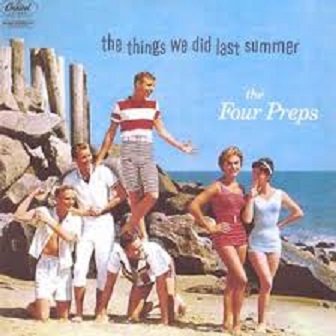
The Four Preps

T

he Four Preps were a white vocal harmony group that recorded for Capitol Records from 1956 to 1967.  Bruce Belland sang lead tenor, Glen Larson, baritone, Marvin Inabnett (later changed to Ingram), high tenor, and Ed Cobb, bass.  Their friend, Lincoln Mayorga, was an unofficial fifth Prep.  He was their musical director, and played piano on and arranged many of their records.  He also accompanied them in concert.  They met while attending Hollywood High School in the early to mid-1950s.In fall 1955, when the school’s annual talent show had attracted only female participants, a desperate call went out to the student body to find guys with any kind of talent.  Belland and company were singers in the school choir, so they quickly formed a group and, drawing on their love for vocal groups like the Crew Cuts, the Four Lads, and the Four Freshmen, worked up an act for the talent show.  They called themselves the Four Preps.  They were a huge hit and began accepting requests to perform at other engagements in the Los Angeles area.  “We didn’t turn anything down,” Belland recalled.  “We once performed on the back of a flatbed truck for the opening of a parking lot.  They paid us seventy-five dollars.  Enough to buy gas and our first matching sport coats.”In summer 1956, they performed at a dance at the University of California, Los Angeles (UCLA) and, unbeknownst to them, a friend, Howard Adelman, taped their performance.  The tape gave Belland and Larson a demo they could shop around.  Mel Shauer, who managed Capitol recording artists Les Paul and May Ford, liked what he heard and asked them to leave the tape with him.  Shauer brought it to the attention of Capitol (probably Voyle Gilmore) and by August 1956 the Preps had a long-term recording contract.  “It was amazing for four teenagers to be signed by Capitol Records,” Belland recalled.  “For starters, it was considered the ‘singer’s label’ in the recording industry with artists like Frank Sinatra, Nat King Cole, Peggy Lee, Kay Starr, and Judy Garland.  But, above all, it was the label of the group we most fervently admired, the Four Freshmen.  Just knowing we were on the same label was a pretty heady experience.  I sometimes wonder if we would even have aspired to form a group and make records if it hadn’t been for their inspiration.”  They were the youngest act to ever sign with a major record label.  Variety called them “Capitol’s jolly juveniles.”  They would go on to release thirty-six singles, several successful albums, and numerous television appearances including four times on The Ed Sullivan Show and fourteen times on Dick Clark’s American Bandstand.On September 14, 1956, they entered the Capitol Tower for their first recording session with Voyle Gilmore producing.  From the sessions, “Dreamy Eyes” (b/w “Fools Will Be Fools,” Capitol 3576) was released October 29.  It was popular on the West Coast and reached a respectable #56 nationally in March 1957.  To help introduce the group and support their debut single, Capitol arranged for them to appear at the California Music Merchants Association’s banquet in the Grand Ballroom of the Ambassador Hotel February 2, 1957.  It was the first time the state-wide association met in southern California.  The Preps had just released their sophomore single, “Moonstruck in Madrid” (b/w “I Cried a Million Tears,” Capitol 3621).On March 23, 1957, the Four Preps appeared at a Campus Debutante Jamboree at the Fox Theater in Bakersfield along with Richard Egan, Elvis’s co-star in Love Me Tender, and Frank Gifford, football’s most valuable player of 1956.  On April 25, 1957, they opened for Monique van Vooren at Fack’s II nightclub in San Francisco.  She was described by the Oakland Tribune as “The curvy Belgium chanteuse who collects mink coats by the dozen and boyfriends.  Men only on opening night so make your reservations now.”   Well, van Vooren may have collected more minks, but the Preps stole the show.  They were invited back for engagements of their own that May and June.  On June 27, 1957, they appeared on season finale of The Tennessee Ernie Ford Show.

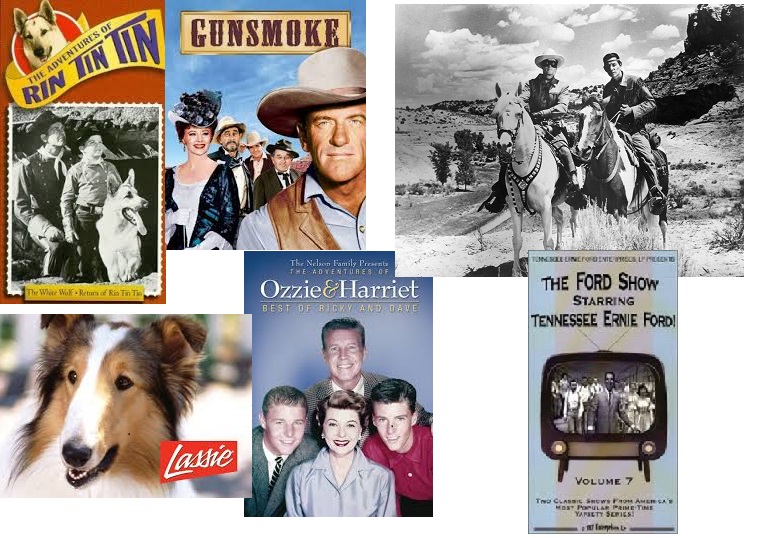
The Four Preps maintained a busy touring schedule during summer 1957.  The Music Corporation of America booked them into the Ohio State Fair which ran August 22-29 in Columbus and drew more than 300,000 people.  The Fair organizers were pleased to book Tennessee Ernie Ford and the Lennon Sisters as the headliners.  But when the Lennon Sisters were unable to convince Lawrence Welk to release them from his Saturday evening show, Ricky Nelson was signed to give four performances over two nights.  The Four Preps soon became good friends with Nelson, who was hugely popular with the teen crowd and less threatening to adults than Elvis Presley, Jerry Lee Lewis, or Little Richard. Nelson was a successful recording artist for Imperial Records and star of the show Ozzie and Harriet still going strong in its fifth season on ABC-TV.  Also appearing at the Ohio Fair were James Arness, who played Sheriff Matt Dillon on Gunsmoke, and canine television star Rin-Tin-Tin.  Arness and the pooch were featured the first two nights with the Holmes Rodeo Company, a popular attraction since Roy Rogers razzle dazzled them at the Fair a year earlier.

Preps collage

From Ohio, Ricky Nelson and the Four Preps traveled to Minneapolis to appear at the Minnesota State Fair on August 26.  They drew an estimated 20,000 kids to a special morning grandstand performance credited with raising “the noon kid day attendance to a record 60,000.”  As Ricky headed home to California, the Preps appeared with Brenda Lee at the 20th Allegheny County Fair in Pittsburgh along with the television stars Clayton Moore (The Lone Ranger), Jay Silverheels (Tonto), and Lassie as himself.  Moore was taking a victory lap of sorts as the final new episode of The Lone Ranger had just shown June 6.  A total of 221 episodes had aired since the popular western debuted in 1949.  On September 13, the Four Preps were back in California, appearing with Ricky Nelson at the Santa Clara County Fair in San Jose.

But while the Preps were honing their skills as live performers, their last four singles had tanked.  They desperately needed a hit as Capitol was beginning to lose faith in their “jolly juveniles.”  Belland proposed recording a song he and Larson composed, but Capitol didn’t see it as the way out of their commercial doldrums.  But Belland was convinced it was a hit because whenever they performed it live locally the response was enthusiastic.  At a spring break party for the Tiara’s, a girl’s club at University High School in Los Angeles, everyone was singing the tune by the end of the night.  One of the Tiara’s was seventeen-year-old Nancy Sinatra whose name and personal endorsement eventually helped convince Capitol to allow the guys to record the song.

The song had its roots in Belland’s childhood growing up in Chicago.  As a youngster, he remembered sitting in a darkened theater watching movie reels of the Chicago Cubs’ spring training on Santa Catalina Island off the California coast.  “I would sit there in the dark and stare at those palm trees waving in the background and wonder ‘How can it be that warm anywhere in the world when it is so cold here in Chicago?’”  He got a little closer to this seemingly exotic island when his family moved to California and he soon started attending Hollywood High.  Then, in 1951, when he was 15, he fell off his bicycle and broke his ankle.  It was an accident that changed his life forever.  While recuperating, he was given a ukulele to help alleviate the boredom.  He learned some basic chords and composed what would become the introduction to the song.  After his ankle healed, he was body surfing at Will Rogers State Beach when a buddy pointed out that he could see Santa Catalina 26 miles away.  “That’s where it came from,” recalled Belland.  “It’s really like 22.3 miles, but you try singing that.  Think about that meter!”

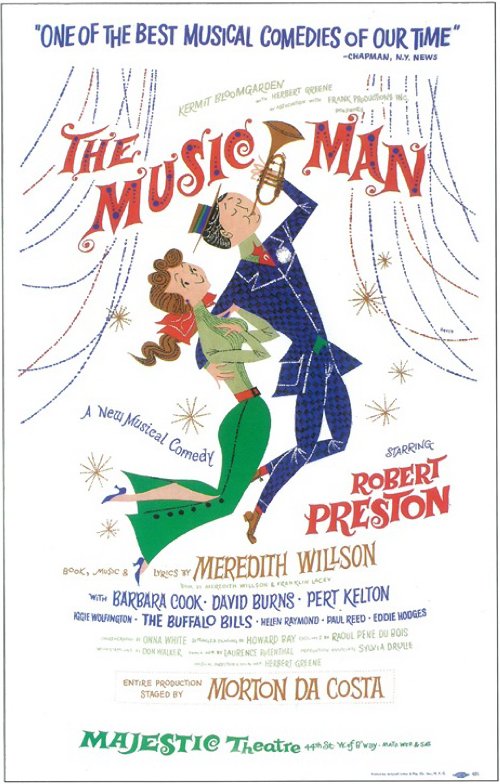
By fall 1957, as the Preps considered their next single, Capitol Records was concentrating its efforts on a major marketing campaign to promote the original cast album for The Music Man, a new musical scheduled to open in the Majestic Theater on Broadway December 19.  In order to secure the rights of the new musical, Capitol had guaranteed a number of their artists would record songs from the show.  Original cast albums were a dicey proposition for any record company.  If the show was a hit, the album sold well and was a tremendous source of revenue.  But if the show bombed, you couldn’t give the album away.

Capitol had mixed results with original cast recordings.  Their first real hit came in 1953 with Cole Porter’s Can-Can.  Original film cast recordings of three Rodgers and Hammerstein musicals (Oklahoma!, Carousel, and The King and I) had each earned gold albums for the label.  But they also had their share of bombs as when they invested in Phil Silvers’ ill-fated musical Flahooly in 1950 (the show was doctored and emerged as Top Banana).  But Capitol had its eye on the phenomenal success Columbia Records had with My Fair Lady the year before.

Columbia was known for exceptional production of cast recordings that fully captured the experience of a Broadway show for millions of listeners who would never have the opportunity to see the show performed live.  Under the innovative eye of engineer Goddard Lieberson, Columbia assembled the musicians and casts in their studios (a converted church) on 30th Street in New York.  The facility’s acoustics and Lieberson’s astute microphone placement gave the recordings an airy, expansive feel.  In 1956, Lieberson persuaded CBS to fully finance My Fair Lady thereby ensuring CBS and Columbia Records the exclusive rights to the original cast recording and subsequent film and television rights.  Of course, the gamble paid off as My Fair Lady opened March 15, 1956, and ran until September 29, 1962, after 2,717 performances.  The cast album reached #1 in Billboard and remained on the chart for an astounding nine years.

The Music Man featured music and lyrics by Meredith Wilson, and starred Barbara Cook and Robert Preston.  Ironically, Cook was in the cast of two of the biggest original cast recording flops, Candide for Columbia Records (1956) and Plain and Fancy for Capitol (1955).  In fact, Capitol had not released an original cast album since Plain and Fancy failed to chart.  But The Music Man had done brisk box-office with advance ticket sales through March 1958 so Capitol pushed forward.

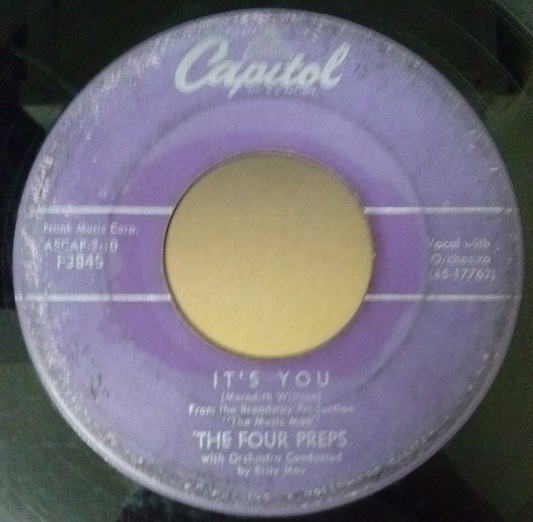
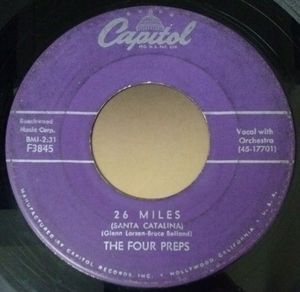
In an unprecedented move, Capitol arranged to record and release songs from the show nearly six weeks before it opened.  It was the first original cast recording made in the new Capitol Tower.  Capitol’s marketing plan called for a total of nine singles and a special “Broadway Preview” EP containing four songs.  Capitol was convinced the Four Preps could have a hit with a tune called “It’s You” that opened the second act of the show.  Voyle Gilmore and the Preps entered the studio October 9 and, as a concession to Belland, Capitol approved the recording of his song, now called “26 Miles (Santa Catalina),” as the B side.  Preps Its You Preps 26 milesWith its infectious melody and pretty vocals, the romantic ballad extols the virtues of an island paradise.  Dick Clark reportedly referred to it as the first surf song.  Belland recalled that the vocal effects on the record were a happy mistake.  “When we cut the record, the drums were too loud, you couldn’t hear the vocal.  Capitol didn’t want to put any more money into it.  They made us go back and sing all four parts over the original recording.  It gave the song this washy sound.  It was like you were hearing the song echo in an underground grotto.”

During the first week of November 1957, Capitol released the “Broadway Preview” EP and three singles—“It’s You” by the Four Preps, “Til There Was You” by Nelson Riddle with a vocal by seventeen-year-old Sue Raney, and “70 Trombones” by Billy May.  The EP packaged these three plus “Lida Rose” by Guy Lombardo (Capitol EAP 1 957).  On December 13, Capitol got a sales boost when Julius LaRosa guested on the ABC-TV The Patrice Munsel Show and the two performed tunes from the show a week before it opened.  Billboard reported, “Neither artist conveyed the sock emotional impact that the music has on stage.  Robert Preston, who doesn’t have any more voice than Rex Harrison, also possesses Harrison’s ability to sell a song via faultless timing and sheer personal magnetism.”

Capitol had gambled successfully.  The New York theater critics were unanimous in their praise for The Music Man.

Broadway's The Music Man original poster

Broadway’s The Music Man original poster

Writing in The New York Times, theater critic Brooks Atkinson called it “a marvelous show rooted in wholesome and comic tradition.”  Another critic wrote “it deserves to run at least a decade.”  The public loved it to the tune of 1,375 performances.  It captured five Tony Awards including best acting in a musical awards for Preston and Cook, and an impressive win over West Side Story for best musical.  When it was made into a film in 1962, Capitol re-released the album and slashed the price by one dollar.  The lads from Liverpool did a version of “Till There Was You” on their debut Capitol album simply because Paul McCartney loved the song.  Meredith Wilson’s widow told The New York Times that his estate made more money from the royalties of the Beatles cover than the play itself.

On December 26, 1950, Capitol hosted a party at Sardi’s in New York to celebrate the show’s second anniversary and present Meredith Wilson with a gold record award for surpassing the million dollar sales mark.  At that time, the Broadway run had grossed more than $7 million and, when coupled with the national touring company, neared $10 million.  Capitol’s experience with The Music Man was so financially lucrative they jumped at the chance to finance Wilson’s next musical.  In spring 1960, Capitol invested $220,000 (more than half of the show’s $400,000 capitalization) in The Unsinkable Molly Brown.  Glenn Wallichs, Capitol’s president, invested $20,000 of his own money.  Meanwhile, The Music Man had recently celebrated its 1,000th performance and the original cast recording surpassed the one million dollar sales milestone.  Capitol’s move signaled the industry they were willing to slug it out with Columbia and RCA Victor in bidding for new Broadway properties.

Ironically, while the Capitol original cast recording of The Music Man was a huge success, not one of the singles released from the show was a hit, including “It’s You” by the Four Preps.  Now their last five singles had not done well.  But in early January 1958, the Preps received the type of vinyl miracle that had rescued so many great songs of the rock and roll era.  A disc jockey somewhere turned their record over and discovered “26 Miles (Santa Catalina).”  Listener response was enthusiastic and the single moved up the chart carrying “It’s You” as the B side.  On March 23, 1958, the Four Preps performed the song on The Ed Sullivan ShowBillboard reviewed their performance and thought they “had just enough amateurishness in their staging to have strong appeal.”  The song remained at #2 for two weeks and became their best-selling record.

The Preps continued their friendship and professional relationship with Ricky Nelson, appearing several times on The Ozzie and Harriet Show.  On December 1, 1958, just as they kicked off a tour together, LIFE magazine put Ricky on its cover with the caption “The Teen-Agers Top Throb.”

Sources:
www.fourpreps.com
Geoffrey Boucher.  “The SoCal Songbook: 26 Miles (Santa Catalina), The Four Preps,” The Los Angeles Times, July 15, 2007.

The Kingston Trio

I

n spring 1957, Frank Werber, was working as a publicist for the Purple Onion, the north-beach area of San Francisco nightclub with a reputation of showcasing new talent during the Beat era, and Hungry i nightclub, also in San Francisco.  One night he stopped into The Cracked Pot, a club in Palo Alto, just east of Stanford University, and music history was made.  Some young musicians had ambled onto the stage, guitars and banjo in hand, promising the club’s owner to entertain in exchange for free beer and pretzels.  Werber listened and knew that what he heard would play all across America.  When they finished, the group sat around a table drinking their pay and munching pretzels.  Werber approached and offered to manage them, providing they lose the bass player.  In the resulting personnel shuffle, three members left and two original members returned, transforming the Kingston Quartet into the Kingston Trio.  Werber wrote a personal management contract on a paper napkin that split everything equally four ways.  Twenty-five percent to each of the Trio and a generous twenty-five percent to himself.  Bob Shane was born Robert Castle Schoen in Hilo, Hawaii, February 1, 1934.  His father was a wholesale distributor of toys and sporting goods in Honolulu and young Bob was expected to take up the family business.  In 1948, he entered Honolulu’s Punahou School, the oldest private school west of the Rockies.  He sang in the Glee Club and appeared in several school plays and variety shows.  In his free time, he hung out on the beach strumming his ukulele and singing Polynesian songs he learned from his Hawaiian friends.  In his junior year, he became friends with Dave Guard, a fellow student at Punahou.  He taught Guard some basic chords on the guitar.  They teamed up to perform at the junior carnival and sang songs by the Weavers, the most popular folk group in the country at the time.  After graduation in 1952, they each moved to California where Guard attended Stanford University and Shane attended Menlo College in nearby Atherton, California.  In his junior year at Menlo, Shane fell asleep in the back of a classroom during a dull accounting lecture.  A classmate, Nick Reynolds, found it amusing and they became good friends.  “I showed up at Menlo not knowing a soul,” recalled Reynolds.  “And the first day I walk into this accounting class and there’s this guy sleeping in the back of the room during the lecture.  So I said to myself, anybody that’s got the guts to do that I’ve got to get to know.  It turned out to be Bobby Shane, and we immediately went out and became really tight pals; I don’t think we showed up for school for about two weeks afterward.”  Shane recalled, “He nudged me and said, ‘Hey, I’m Nick Reynolds – have you got a car?  Mine just blew up.’  We started singing the first day we met.  Nobody could nail a harmony part like Nick.  He could hit it immediately, exactly where it needed to be, absolutely note perfect.  Pure genius.”

Kingston Trio Nick Reynolds, Bob Shane, and Dave Guard

Original Kingston Trio members
Nick Reynolds, Bob Shane, and Dave Guard

Nicholas Wells Reynolds was born July 27, 1933, in San Diego, and grew up in the affluent suburb of Coronado, a peninsula separated from the mainland by a ten-mile wide strip of land called The Silver Strand.  Stewart Reynolds, Nick’s father, was a captain in the United States Navy, which maintained a large base at Coronado, including the training center for Navy SEALS.  Stewart  played guitar and would gather Nick and his two sisters, Barbara and Jane, and sing old folk tunes  and native songs he learned from his world travels.  Nick played the bongos and some guitar.  After graduating from Coronado High School, Reynolds attended the University of Arizona, San Diego State University, and then Menlo College where he met Bob Shane in that dull accounting class and soon discovered their common interest in music.  They formed a duet, with Shane on guitar and Reynolds on bongos, and entertained at school functions, frat parties, and beer gardens.  Within a few weeks, Shane introduced Reynolds to Dave Guard who was still at Stanford.  Shane and Guard taught Reynolds how to play some genuine Hawaiian songs on guitar and they began playing two nights a week at a local tavern and as many frat luaus they could squeeze in.  After graduation, Shane returned to Honolulu and began putting his business degree to work for his dad’s company.  He also wanted to pursue a solo singing career as ‘Hawaii’s Elvis Presley.’  Guard and Reynolds added Joe Gannon on bass and singer Barbara Bogue, and called themselves Dave Guard and the Calypsonians.  They auditioned at the Italian Village, a popular San Francisco nightclub, where Frank Werber spotted them.  Werber suggested Guard and Reynolds drop Gannon as he was not skilled musician and they’d get more bookings as a trio.  But Reynolds left after his graduation and was replaced by Don McArthur.  The group was now called The Kingston Quartet.  Around this time, Werber encouraged Reynolds to return and Gannon was dropped from the group.  “Joe wasn’t really a bass player,” recalled Reynolds.  “He was just standing there faking it like a gut bucket.  So Barbara goes ‘Well, if Joe goes, I go.’  Well, I’d kept in touch with Bobby [Shane] and I told him there was a chance of getting a gig if we really worked at it.  So he came back and the three of us got involved with Frank.”  Bob Shane had tired of the wholesale toy and sporting good business.  Furthermore, his career as ‘Hawaii’s Elvis Presley’ had not taken off so he welcomed the opportunity to return to California as part of the Kingston Trio in spring 1957.

“It really started with the Weavers in the early 1950s,” recalled Reynolds.  “Goodnight Irene,” “On Top of Old Smokey,” “Wimoweh.”  We were big fans of theirs, but they got blacklisted in the McCarthy era.  Their music was controversial.  Suddenly, they couldn’t get any airplay, they couldn’t get booked into the big hotels, nothing.  We played their kind of music when we were first performing in colleges.  But when we formed the Trio, when we first got booked into San Francisco’s Purple Onion, we had to sit down and make a decision: Are we going to remain apolitical with our music?  Or are we going to slit our throats and get blacklisted for doing protest music?  We decided we’d like to stay in this business for a while.  And we got criticized a lot for that.”  Interestingly, Jerry Wexler resigned from Billboard magazine because he refused to write a dossier on the Weavers that would contribute to their being blacklisted.  It was Wexler who coined the term Rhythm and Blues which the music weekly adopted June 25, 1949, for its black music chart which had been called Race Records.  Wexler then worked briefly as promotions director at MGM studios.  He declined Ahmet Ertegun’s offer to work for Atlantic Records, preferring instead full partnership.  When Atlantic co-founder Herb Abramson was drafted into the Army, Ertegun relented and Wexler bought a thirteen-percent share of the company for $2,063.25.

Werber hired San Francisco vocal coach Judy Davis and rehearsed the Trio in his office above the Purple Onion until they had near-perfect vocal harmony and a repertoire that consisted of three hours of songs.  Kingston trio purple onionThey readied a twenty-five minute set for a one week gig opening for comedienne Phyllis Diller on Memorial Day weekend 1957 at the Purple Onion.  Mort Sahl, Shelly Berman, and Ronnie Schell had been discovered there.  Dave Guard mailed 500 postcards to everyone they knew at Stanford University and Menlo College, inviting them to the Onion.  Word of mouth spread and the initial week turned into two.  That July 1 they began headlining at the Onion for seven months.  During that run, they polished their stage act, interspersing their intricate harmonies with comic banter that always seemed spontaneous.  Reynolds, whom the other two called budgie or runt of the litter, often provided the comic zingers.  The Kingston Trio revitalized American popular music, paved the way for the folk music revival, and set the stage for the protest music era of the early sixties.  And in the late 1950s, they represented a wholesome, clean-cut alternative to the sexualized rock and roll of Elvis, Chuck Berry, Jerry Lee Lewis, and Little Richard.  Parents approved of the Kingston Trio.  It was safe for their children to listen to their music or attend one of their concerts.

Kingston trio2The Kingston Trio continued to wow audiences at the Purple Onion.  Jimmy Saphier, Bob Hope’s agent, caught their show and brought their demo tapes to Dot Records and Capitol Records in Los Angeles.  Randy Wood at Dot passed apparently, but Capitol was intrigued and sent Voyle Gilmore to see the Trio in person.  Capitol, of course, had Frank Sinatra, the Four Freshmen, and the Four Preps on their roster and were always looking for new artists with youth market appeal.  Gilmore liked what he heard and signed the Trio to a seven year recording contract.

In February 1958, after their successful seven-month stint at The Purple Onion, Frank Werber decided the Kingston Trio needed to be performance-tested before different and tougher audiences.  He booked them into the Holiday Hotel in Reno, Mr. Kelly’s in Chicago, and the Blue Angel and the Village Vanguard in New York.  Between the Reno and Chicago dates, the group flew back to Los Angeles to record their first studio album for Capitol Records.  On February 5 and 6, Voyle Gilmore produced eleven recordings by the Trio in Studio B at the Capitol Tower.  On February 7, the Trio recorded a twelfth song, “Little Maggie,” and a thirteenth number, “Dodi Lii,” which was left off the album, but appeared as simply “Dodie” on their second album From the Hungry i.  With the Trio, Gilmore, who had produced many of Sinatra’s legendary sessions in the 1950s, made two key decisions that shaped their distinctive sound.  He hired a bass player to anchor their recordings and he resisted adding orchestral instrumentation, a common production practice at the time.

On May 1, 1958, the Kingston Trio made their national television debut on the CBS drama Playhouse 90 where they appeared in Rumors of Evening portraying World War II pilots.  They also introduced and sang their soon-to-be-released debut single “Scarlet Ribbons.”  On May 5, Capitol Records released “Scarlet Ribbons” (b/w “Three Jolly Coachmen,” Capitol 3970).  The single, however, failed to chart.  On June 1, 1958, Dave Guard’s wife, Gretchen, gave birth to their first child, a baby girl.  The following day, Capitol released the Trio’s eponymous debut album The Kingston Trio (Capitol T/DT 996).

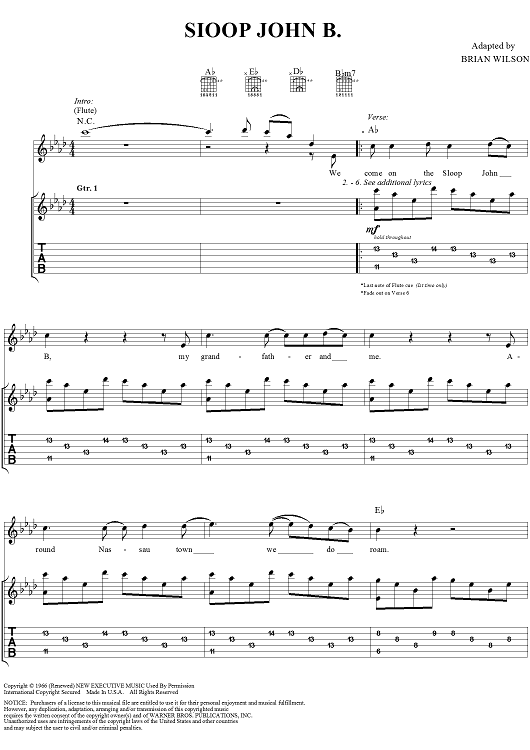
Sloop John B. sheet music

Sloop John B. sheet music

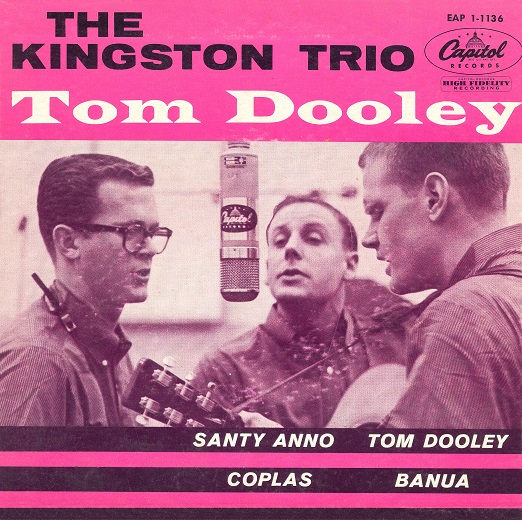
The thirty-one minute album contained at least two songs that had a profound influence on fifteen-year old Al Jardine—“Tom Dooley” and “Sloop John B.”  The album enjoyed one week at #1 and an astounding 196 weeks on the Billboard album chart.

On June 19, 1958, disc jockeys Bill Terry and Paul Colburn at radio station KLUB in Salt Lake City, began playing “Tom Dooley” from their debut album.  That July, they were still playing “Tom Dooley” and becoming increasingly frustrated Capitol had still not released it as a single.  Listener requests poured in and other radio stations across the country began adding the song to their play lists.  Although the song was readily available on the Trio’s debut album, this was the age of the 45 rpm single and the record-buying public wanted to know where and when they could buy it.

On September 8, as Al and Brian began their junior year at Hawthorne High School, Capitol Records, in response to requests from radio stations across the country, released a second single from the Trio’s debut album, “Tom Dooley” (b/w “Ruby Red,” Capitol 4049).

On September 17, the Trio appeared in concert with The Cal Tjader Quintet at the Memorial Auditorium in Fresno, California.  The concert was sponsored by the Fresno Junior Chamber of Commerce.  Reviewing the concert in the Fresno Bee Republican, James Bort, Jr., clearly preferred Tjader’s renditions of jazz standards.  Of the Trio, he wrote “The Kingston Trio will leave little mark musically, but it has a heck of a lot of fun, mostly clowning its way through a series of hillbilly, Latin, and calypso things to the great delight of the audience.  The occasions when it attempted serious renditions of folk ballads (“Tom Dooley,” for instance) it fell short.  Basically, the trio gives the impression of a polished version of a college act, which is what it is.”

By October, record executives on both coasts were keeping an anxious eye on the rapid ascent of “Tom Dooley” up the charts.  Anticipating a spike in popularity of folk music, record companies were checking their A&R rosters in the event folk music became the next hottest trend.

In mid-October, Jerry Dexter and Bob Salter, two Las Vegas disc jockeys, urged their listeners to sign a petition to grant Tom Dooley a new trial and a stay of execution from the gallows.  More than half of the callers to the station believed Dooley was a real person languishing in the Clark County Jail accused wrongly of murder.  More than two hundred signatures were collected and presented to Nevada Governor Charles Russell, who had no comment on the case.  But not everyone was amused.  Sheriff W. E. “Butch” Leypoldt, running for re-election at the time, was flooded with calls to release Dooley.  He pleaded with the station to “stop all this foolishness.”  But Dexter and Salter were not to be dissuaded.  They staged such a realistic on-air trial that listeners believed it was coming from the county courthouse.  Finally, the station flashed a bulletin that Dooley had been acquitted and that new evidence presented led to the conviction of Mr. Grayson (another character in the song).  Students at the Las Vegas Southern Nevada University hosted a Tom Dooley Victory Dance.  In protest, the anti-Dooley contingent hung poor Tom in effigy from a 40-foot tree in front of City Hall.  The Van Nuys News reported, “Jubilant, Dexter and Salter hustled Dooley out of the state.  They will not reveal his exact whereabouts, but it is rumored he was seen in Denver, where dj Royce Johnson was tarred and feathered (with molasses and popcorn) for playing Tom Dooley for 24 hours straight.”

But the character of Tom Dooley and the events in the song were based on a sordid murder trial in North Carolina after the Civil War.  Thomas C. Dula was a handsome young banjo picker who had earned a reputation for bravery while fighting for the Confederacy.  After the battle of Gettysburg, Dula returned home to Happy Valley in Wilkes County, North Carolina, where eighteen-year-old Laura Foster made her affection for him known.  Although Tom had his eye on her cousin, Ann Melton, a wealthy, married socialite, he was not above seeing Laura on the side.  When he contracted a venereal disease, he vowed publicly to get even with her.

On May 25, 1866, Laura vanished.  Her body was discovered three weeks later in a mountainous wooded area.  She had been stabbed through the heart.  In addition to Tom, there were two other prime suspects—Jack Keaton and school teacher Bob Cummings.  Cummings is known as Mr. Grayson in the song.  Both Keaton and Cummings were suitors and, along with several other suitors, had disappeared from Happy Valley the day after her body was discovered.

A month later, Cummings rode back into town with Dula and Keaton in tow.  He had found them hiding in Tennessee.  Keaton came up with an alibi, so Dula went to trial where he was defended by former North Carolina Governor Zebulon Vance.  Ann Melton was also accused of Laura’s murder.  Dula was convicted once, granted a new trial by the state supreme court, and convicted again.  Dula was publicly hanged May 1, 1868, in Statesville, North Carolina, for the murder of Laura Foster.  His coffin rode atop a horse drawn wagon.  Shortly before he died, Dula helped exonerate Ann Melton by scribbling a note stating, “I am the only person that had a hand in the murder of Laura Foster.”

By November, “Tom Dooley” was #1 on the Hot 100 and #9 on the R&B chart.  It remained on the charts for five months and would be the Trio’s only gold single, selling more than six million copies world-wide.  Meanwhile, the Trio had flown to Honolulu for a little rest and recreation, and to appear at the opening of the Surf Room at the Royal Hawaiian Hotel.  Frank Werber received a frantic phone call from Capitol’s Voyle Gilmore.  “Get those boys back here.  Tom Dooley is going to hit number one.  It looks like you’re going to have the record of the year.”  The Trio also had a huge impact on the popularity and sales of Martin guitars.  The company built a new factory in Nazareth, Pennsylvania, to keep up with demand.

On November 16, the Trio played the Woodrow Wilson Junior High School Auditorium in San Jose, California.  It was a sort of triumphant Bay-area homecoming for them as “Tom Dooley” was #1 in the country.  On November 19, they appeared on NBC’s Kraft Music Hall with Milton Berle.  They sang “Tom Dooley” with actress and sex symbol Barbara Nichols who one reviewer reported “adds her nasal whine.”

The December 15 issue of LIFE magazine featured an article on the Kingston Trio entitled “Hanged Man in Hit Tune.”  On December 27, the Trio performed at the LA Palladium.  Two days later, Capitol released their third single, “Raspberries, Strawberries” (b/w “Sally,” Capitol 4114) which reached #70 on the Hot 100.

In early 1959, the Trio played the LA Shrine Auditorium to a crowd of 8,000 fans.  On April 24, the Trio packed them in at the Pasadena Civic Auditorium.  Warming up the crowd was clarinetist Gus Bivona and his jazz band.  Since the success of “Tom Dooley,” concert bookings for the Trio had skyrocketed and this show was touted as their only southern California appearance.  The Trio would soon appear on more national television shows as guests of Milton Berle, Perry Como, and Dinah Shore.  They also made a return appearance on Playhouse 90.  “‘Tom Dooley’ was a haunting, century-old folk song with a lot of meaning and a good story,” Nick Reynolds told a reporter.  “Although we’ve sung it at least 4,000 times, it still gets the biggest applause.”

As the Trio became more successful, they were constantly looking for new material.  They poured over old songbooks and listened to old records, drawing on native rhythms from countries all over the world.  Dave Guard discussed the criteria the group used in selecting new material with a reporter from The Daily Review in Hayward, California.  “As we progress musically, in search of new material, we put only one restriction on the type of songs we will do.  They must have a basic intelligent thought and be founded in good taste.”

On May 23, 1959, The LA Times reviewed the Trio’s night club debut at the Cocoanut Grove during the preceding week.  John L. Scott reported, “While the Trio opened to a medium-sized audience of first-nighters, the week end tells a different story.  Maitre D’Hotel Michael Chumo has so many reservations from the college crowd that he doesn’t know where he’ll put them all.  Made up of Dave Guard, Bob Shane, and Nick Reynolds, three young lads with fair to middling voices, the Kingston Trio utilizes a pseudo folk music style.  Rapid rhythms, however, are geared for their youthful fans. Included on the program are two of the boys’ hit recordings, “Tom Dooley” and “Tijuana Jail” (each sold a million).  They also bounce through “Coplas,” “Maria,” “Zombie Jamboree,” and a frenetic rendition of “When the Saints Come Marching In.”

In the audience that night at the Cocoanut Grove was John Stewart, a singer-songwriter contracted to Arwin records and scheduled to soon make the switch from rock and roll to folk.  Stewart managed to meet the Trio after the show and played them two songs he had written, both of which the Trio would later record—“Molly Dee” (June 2, 1959) and “Green Grasses” (September 28, 1959).

On June 8, 1959, the Trio released their fifth single, “M.T.A.” (b/w “All My Sorrows,” Capitol 4221).  M.T.A. stood for the Massachusetts Transit Authority and was written to protest a subway rate hike during a mayoral election in Boston.  The novelty song, sung to the tune of “The Wreck of Old 97,” stayed on the charts for eleven weeks and peaked at #15 on the Hot 100.

The Trio on the cover of LIFE

The Trio on the cover of LIFE

In July, Columbia Pictures released The Legend of Tom Dooley starring twenty-three-year-old Michael Landon as the ill-fated Dooley, although the plot bore no resemblance to the true story that inspired the song.  The Trio’s “Tom Dooley” was featured in the film.  On July 14, the Trio appeared on The Jimmie Rodgers Show and on August 3 they graced the cover of Life magazine.

In December 1959, the Trio began work on Sold Out, their sixth Capitol album, which reached #1 for twelve weeks in spring 1960.  On December 8, they recorded one of Al Jardine’s favorite Kingston Trio songs, “Raspberries, Strawberries.”  The album version of the song featured a smoother arrangement with tighter vocals than the single that had been rush-released December 29, 1958, as the follow-up to “Tom Dooley.”  In 1969, Al recorded a version of “Raspberries, Strawberries” the Beach Boys considered for their Sunflower album the following year.  The song did not make the cut and remains unreleased.

The Tikis

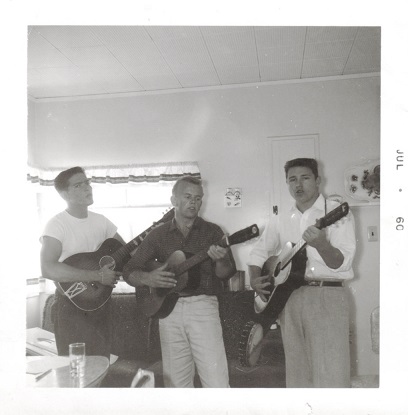
In spring 1959, Gary Winfrey, Al Jardine, and Bob Barrow formed a folk music trio called the Tikis, inspired by their shared admiration for the music of the Kingston Trio. When I began researching the book, Bob and Gary graciously spoke with me about their days at Hawthorne High School, their friendship with Al Jardine, and the Tikis. I am happy to share more of their stories.

Bob Barrow
As the Kingston Trio’s Tom Dooley hit big in fall 1958, the start of their junior year, Bob Barrow, Al Jardine, and senior Gary Winfrey, discovered a shared musical interest in the Kingston Trio and began singing selections from the Trio’s eponymous debut album after football practice in the locker room of Hawthorne High School. By spring 1959, they formed a folk music trio called the Tikis. Although Brian knew Jardine, Barrow, and Winfrey from football, he didn’t socialize with them off the field. But he certainly knew of the Tikis. Everyone at Hawthorne High did. The musical spark that motivated Jardine to help form the Tikis later played a key role in the development of the Beach Boys.“The Kingston Trio had just come out with Tom Dooley and we would sing it after football practice in the locker room,” recalled Gary Winfrey.

“We enjoyed singing so Al, Bob, and I formed a group called The Tikis. We would spend hours practicing Kingston Trio songs and writing some of our own songs at my parents house.” Al encouraged Bob to learn how to play guitar and Bob began taking lessons. Bob recalled, “I took one guitar lesson at Hogan’s House of Music, but then I broke my thumb playing football so I quit taking lessons, got chord books, and learned from Al. The Tikis were nothing more than just me, Al, and Gary playing guitars over at Gary’s house most of the time. I think Al came up with the idea of the name for the group. I think it was an extension of the beach thing. A tiki was a wooden Hawaiian carving that you wore around your neck. We did whatever kind of folk music we could at the time, which was mainly the Kingston Trio. I think the only one of us that had any thoughts of getting serious about the music business would have been Al. I think there was a little more in Al’s mind than just kicking back and having fun. He was a natural musician. He had a love of music and music was in his blood. At that time, people were all into ‘Well, you know you need to go to college and get a career.’ He was planning on taking a traditional path, but I’m sure in his mind that if an opportunity opened up in music that would be something he would love.”The temperate southern California climate allowed the Hawthorne gridiron guys to play their favorite sport even during the summer. Barrow recalled, “On Saturdays, especially in the summer prior to football season, we’d meet at Richard Henry Dana Middle School’s playing fields and play touch football. People would wear their cleats, but also wear shorts. We’d have as many as twelve or thirteen people on a team. We’d play for hours and then go down to the hang-out, the A&W on Hawthorne Boulevard. We’d get a couple of gallons of root beer and go over to Gary Winfrey’s house because Gary had a reel-to-reel Wollensak tape recorder. We thought it was big deal that he had a tape recorder. That’s the reason why we’d go over to Gary’s all the time. You could actually record and then listen to yourself. It was just for fun. We’d have a touch football game, get some root beer, go over to Gary’s house, put our feet up, play guitars and sing, and then listen to ourselves. We’d spend the good part of a Saturday on a pretty regular basis doing that. It was a really good time. That’s where the notion of calling ourselves the Tikis and then, I understand, later they used the name the Islanders, but that notion came about from those sessions. It was really kind of a garage band type activity except it was folk music oriented. We’d play a lot of Kingston Trio. We never played any concerts outside of our living rooms. And Al took the words of The Wreck of the Hesperus by Longfellow, which we had in our English class, and put it to music and we would sing that one.“Al used to come over to my place quite a bit. My mom and dad just loved him. They called Al ‘Hungry’ because the first thing he would do when he showed up was ask if there was anything in the fridge. We were sitting on the back porch and there was a dryer vent there and there was steam coming out of it and Al said, ‘What’s that?’ and I said, ‘That’s steam from the washing machine.’ So he starts strumming away a big blues riff and singing this song called “Steam from the Washing Machine” just for fun. He would make songs up from whatever would be around.”

Barrow recalled, “Al is a really sincere, good-hearted person. He has a sweet spirit about him. That’s why my mom just thought the world of him as one of the friends I had in high school that she just really loved. He had a real charm about him. He’s a stable, dependable guy. The Beach Boys had some tumultuous lives and, as they were having their issues and their problems, Al was always stable. He wasn’t going out doing a bunch of stuff that would make him incapable of performing. Al was always able to step up and be under control. Al started me playing the guitar. He also showed me the basic chords on the piano in the key of C.”

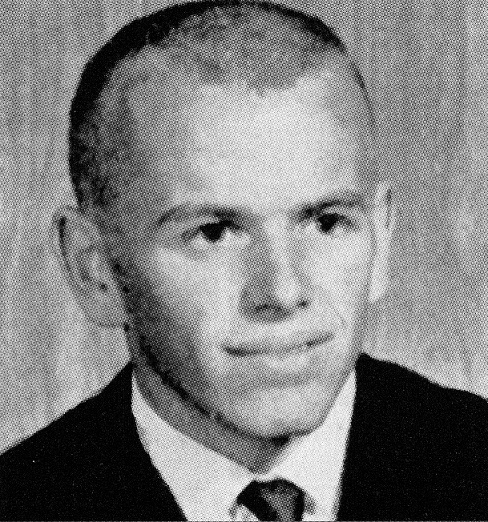
Al Jardine, class of 1960

 Al Jardine, Hawthorne H.S. class of 1960

Bob Barrow was born in Tulsa, Oklahoma, in 1942. Shortly after the end of World War II, his family moved to California and settled in Culver City. Bob has two brothers, one eight years younger and one sixteen years younger. Bob attended sixth and seventh grade at Culver City Junior High School. “I was kind of a bookish type person in junior high school,” Barrow recalled. “My dad was never involved in sports. As a kid he never threw a baseball to me, never threw a football to me. That wasn’t an area of interest. So I had no sports skills. But when I hit junior high and they had PE (physical education), I would ask ‘Well, what position will I play?’ when we were going out to play baseball and they would say ‘left out.’ And I can remember hiding in the locker room and crying because I didn’t want to go out to PE at Culver Junior High. So I never intended to go out for sports.”

In 1955, the Barrows bought a house in Hawthorne on Judah Avenue just over the fence from Richard Henry Dana Middle School, at 135th Street and South Aviation Boulevard, where Bob enrolled for eighth grade. Like many Dana students, including Gary Winfrey, Bob then went to Hawthorne High School. “During my freshman year at Hawthorne High School, my mom, who was a checker at the Thrifty Market grocery store beside Hawthorne High School, had a box boy who was a big, burly wrestler and football player. He got me behind the gym and twisted my arm, literally, and marched me into the coach’s office and told the coaches I was going out for wrestling. I found out that I had some sports ability and ended up playing sports and ultimately I got a football scholarship to Brigham Young University.”

Barrow’s early musical taste was shaped by a chance encounter with one of the radio stations in Los Angeles that played music by black artists. “I heard some music on the radio that I really found intriguing and I thought, ‘Wow, this is some really good music.’ It was “Smokestack Lighting” by Howlin’ Wolf, classic electric blues that didn’t get played on the radio much in those days because it was black music. I loved the guitar riff in it. [Note: “Smoke Stack Lighting” b/w “You Can’t Be Beat” by Howlin’ Wolf on Chess Records 1618 was released in March 1956]. Chuck Berry, Little Richard, stuff like that, were my favorites. When I was on the football team as a senior, they paid me fifty-cents to stand up on top of a table in the cafeteria and do a Little Richard imitation doing “Long Tall Sally.” Then folk music started coming in and we started listening to the Kingston Trio.”

Gary Winfrey
Gary Winfrey was born in January 1942 in Phillips, Texas, a town named for the Phillips 66 petroleum company at which Gary’s father was employed. Because gasoline was such an essential commodity during the war years, Gary’s father was not initially affected by the draft. However, as the war continued into 1945, the need for additional service personnel increased.

Gary Winfrey, Hawthorne High School class of 1959

Gary Winfrey, Hawthorne H.S. class of 1959

Gary’s dad was drafted and was completing his basic training when the war finally ended. In 1946, the Winfrey family moved to Hawthorne, California. Gary attended two elementary schools in Hawthorne—Juan Cabrillo on 135th Street and Juan De Anza on Hindry Street. From there he attended Richard Henry Dana Middle School from grade six through eight. In September1955, he enrolled at Hawthorne High School and graduated in June 1959.

“In my junior year at Hawthorne [September 1957], I played on the B football team. That’s when Al joined the team. I really didn’t know him that well. We knew each other from the football team, but we weren’t friends. We were teammates, but I don’t think I knew him as a friend at that point. I didn’t go over his house or anything. So, when he broke his leg during a game that season, at the time I probably said something like ‘Oh, yeah, Al got hurt.’ But it didn’t stick in my mind that my friend got hurt.”

“The music I was listening to before high school was the typical rock and roll, which was in its infancy then. In the beginning of my senior year, and Al’s and Brian’s junior year [September 1958], the Kingston Trio came out with ‘Tom Dooley’ and it was a big hit. We all liked their music so we started singing ‘Tom Dooley’ in the shower after football practice. We kind of thought that was fun. So in spring 1959, just before I graduated from Hawthorne High, we started a group called the Tikis with Bob Barrow, myself, and Al. We just started practicing and we actually didn’t have a name at the time. We just got together and liked to sing the Kingston Trio stuff. We tried to learn every song they had. I don’t remember how we got the name The Tikis.”

Sources:
Bob Barrow, interview by author, July 12, 2008.
Gary Winfrey, interview by author, July 2008.

The Four Freshmen

O

n March 21, 1950, bandleader Stan Kenton, touring with his Innovations in Modern Music, was playing a jazz club in downtown Dayton, Ohio, when someone told him there was a terrific vocal quartet playing across town in the Esquire Lounge. After Kenton finished his show, he went over to the Esquire to see what all the fuss was about. Kenton was impressed. The guys harmonized beautifully and sang complicated five-note jazz chords with four voices. As a major Capitol artist and stockholder in the company, Kenton had considerable clout. He called a producer at Capitol and arranged an audition for the group in New York City. Pete Rugolo, Kenton’s former arranger, produced the session at which the quartet recorded five tunes—“Laura,” “Basin Street Blues,” “Dry Bones,” and two others.

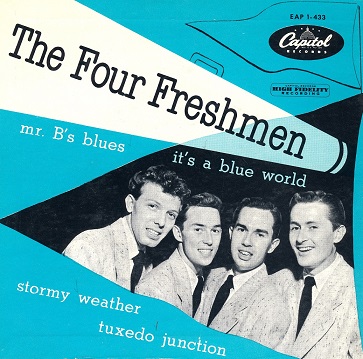
Capitol president Glenn Wallichs liked what he heard and gave Kenton the green light to invite the band to Los Angeles. Kenton arranged for a one week engagement at Jerry Wald’s on Sunset Boulevard. When public demand stretched one week into eight, Capitol knew they were onto something and offered them a recording contract. On October 13, 1950, they recorded their first single “Mr. B’s Blues” (b/w “Then I’ll Be Happy,” Capitol 1293) released that November.

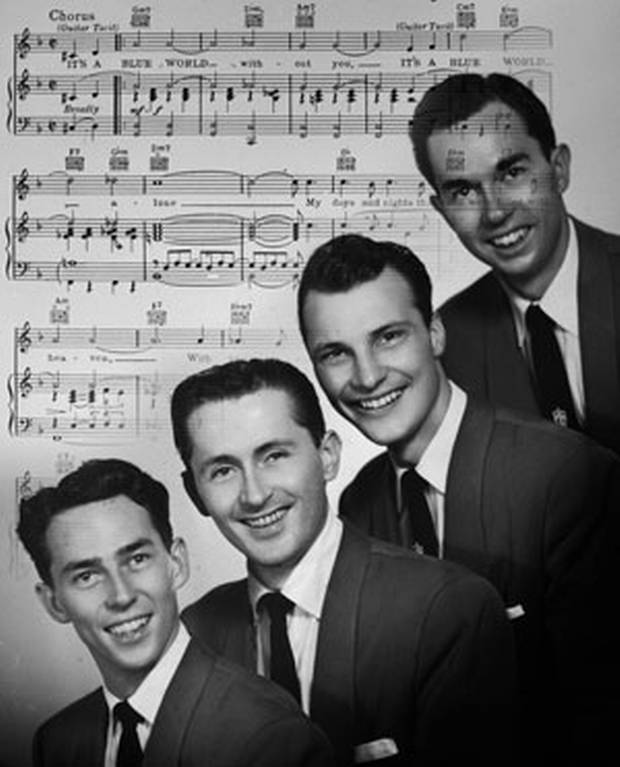
The Four Freshmen were Don Barbour, second tenor and guitar, his younger brother, Ross, baritone, trumpet, piano, and drums, Bob Flanigan, their cousin, lead tenor and trombone, and their friend Hal Kratsch who sang and played bass, trumpet, and mellophone. They met during their first year at the Arthur Jordan Conservatory of Music at Butler University in Indianapolis. Four freshmen2Although they were all freshmen at Butler, they were not all the same age because a few of them had already served in the military.

“We all grew up singing harmony parts with our families,” recalled Flanigan. “Don and Ross were singing barbershop. I wasn’t involved in that. When they decided they wanted to do something else, I went in with the group. I had a high tenor voice,” recalled Flanigan. “With the Freshmen, the Barbour brothers set the unison sound in the group because they both had the same timbre in their voices,” Flanigan explained. “I had a similar timbre, but not quite the same. I never had a vibrato, so that’s why we never used it.”

“We were in college together, studying to be music teachers, and that’s where we started singing together. We envisioned ourselves just singing in college, having a good time doing it, and then we decided we had something worthwhile and decided to go on the road.” They first called themselves Hal’s Harmonizers and later the Toppers. Flanigan continued, “We started off singing a cappella, but all of us also played instruments, so on the road we started playing as well as singing. We copied things Mel Torme did with his Mel-Tones, and Artie Shaw, and Stan Kenton. We were only going to go on the road for a year, and then go back to school, but we started doing some business and said, ‘Okay, one more year.’” In Chicago, they signed with agent Bill Shelton who renamed them the Freshmen Four. They soon reversed it to the decidedly more melodic Four Freshmen and continued to play nightclubs.

“Then we met Stan Kenton and he became very interested in the potential of the group,” recalled Flanigan. “That triggered it and we kept doing it. We never went back to college. We were in our freshman year when we quit.” The November 18, 195O, Billboard reviewed “Mr. B’s Blues” and noted, “A spirited new group makes a promising disk debut with a sock reading of this blues written by Billy Eckstine.” Their sophomore effort was “Now You Know” (b/w “Pick up Your Tears and Go Home,” Capitol 1377). The February 3, 1951 Billboard said: “A promising instrumental-vocal quartet turns in a tasty slicing of a pleasant ballad.” Despite the critical success, neither single charted. “Then we had a thing called “It’s a Blue World.” We were going to Detroit for an engagement and we had a friend who was a dee jay there. He said ‘Give me something I can play.’ So we gave him ‘Blue World.’ It got 40 plays in one day. That record launched our career.”

In July 1952, the Four Freshmen released “It’s a Blue World” (b/w “Tuxedo Junction,” Capitol 2152). The song charted August 23 and reached #30. “At the time, vocal groups were starting to decline in popularity,” recalled Ross Barbour. “The Ink Spots and the Mills Brothers were still going strong, but many of the orchestras were getting away from using vocal groups. ‘It’s a Blue World’ proved to Capitol that this kind of sound would still sell to people. We were distinctive. People heard something in us that they had not heard from other vocal groups. We let the bass note of the chord, the tonic note, be played by the bass instrument and that freed us up to sing five-part harmony with four voices. And one of those four voices would sing a ‘color note’—an unexpected note, a note that wasn’t logical, a note that would surprise the listener and make the song sound more interesting. We were interested in doing music, not just having hits.”

“‘It’s a Blue World’ made me cry,” Brian revealed in a 2006 interview. “I learned to make four-part harmonies from the Four Freshmen. I had to work at it and I finally got it. The Four Freshmen, the Four Preps, the Hi-Los, groups that made pretty harmonies. I analyzed their sound and learned how to make my own harmonies.”

Although forever associated with the Kingston Trio, Al was also a big fan of the Freshmen sound. “The Four Freshmen did everything,” recalled Al. “They played their own instruments. They sang. And they were wholesome. And boy could they sing harmonies. Bob Flanigan, his soprano was incredible.”

The Hi-Lo’s, another popular vocal group in the 1950s, did not have quite the same impact on Al as the Freshmen. “The Hi-Lo’s are something I never really got into,” recalled Al. “I never got into their sound at all. The Hi-Lo’s are a little bit too high. When we started out, Brian and I listened to the Four Freshmen. The Hi-Lo’s were a bit too far out for us.”

On June 13, 1955, a week before Brian turned thirteen, the Four Freshmen released their twelfth single, “Day By Day” (b/w “How Can I Tell Her,” Capitol 3154). “My Mom turned me on to them. She turned the radio on and goes, ‘Hear that song? This is called “Day By Day” by the Four Freshmen.’ And I listened and I went, ‘Oh, I love it, Mommy! I love it!’” “She took me to Lishon’s Records. We went in and she said you can take records into these little booths and play them to see if you wanted to buy them. So I took a Four Freshmen album in and I absolutely—something magical happened to my head. I instantly transcended. Whew! It gave me so much spiritual strength. It came out of me. You know how you sit in a sauna bath and your pores open and the sweat will come out? That’s what that whole experience in that room started to be. I purged all kinds of bullshit and picked up the Freshmen. It was magic. Total magic.” “I listened to the whole album in the booth. I walked out and went, ‘Oh please, can I please have it, Mommy? Please buy it.’ So she bought it for me.”

Brian recalled, “They had the most unique harmony, the best arrangements and a fantastic blend of voices. But they didn’t reach the teenagers. They played and sang at the adult market.”

Brian spent hours at the piano playing his favorite Four Freshmen songs by ear. But Brian didn’t listen to records like most kids. He studied them. He analyzed how the component parts comprised the overall sound. He cut his musical teeth de-constructing the complex jazz harmonies of the Four Freshmen. He spent years—from age thirteen to eighteen—in disciplined self-study with just a stack of records and a piano. It was a rigorous musical education that paralleled, and eventually surpassed, his formal education at Hawthorne High. He got music. He understood it. He saw how the instruments played off one another, how they meshed with the voices, how harmonies were structured and layered. He was fascinated by how a beautiful melody stirred deep emotions in a listener. How did notes and chords conjure the feeling of being in love? Music was pure and non-judgmental. It assuaged whatever teenage problems, fears, or insecurities he felt. Unlike inter-personal relationships which could be difficult to navigate, music never disappointed him. It eventually brought him admiration and love. It made him feel good about himself. It was a gift he would learn to channel to make other people feel good about themselves.

Ross Barbour reflected on why he thought Brian was so captivated by the Four Freshmen. “Although I have never had this confirmed, I feel certain that what intrigued Brian about our sound, in addition to the long tones and sustained harmonics, was that we were singing overtones. An overtone is when a note is sung true by one singer and a little bit different, just a little flat or a little sharp, by another singer. The resulting overlap, or overtone, creates an interesting sound that tricks the listener’s ear into hearing a note that is not actually in the chord. Pop vocal groups had not done that before. Don, Bob and I came from a very musical family. My mother’s father, Elias Fodrea, and my grandmother had twelve children—ten girls and two boys. When the family got together, we’d all sing church and folk songs. We’d be scattered throughout three rooms in this brick house, all of us singing the same song. When you heard those overtones, it became habitual, you just wanted to keep hearing them and be surrounded by them. You wanted every chord to have them.” Ross also credited the Freshmen sound to “opening up the chord.” That’s when one of the middle notes of a chord is sung a full octave lower. That stretches the chord and makes it sound fuller and richer.

A pivotal event in Brian’s life occurred when Murry took him to see the Four Freshmen in concert on Sunday, May 18, 1958, at the Crescendo night club in Los Angeles. Audree Wilson recalled, “In fact, when Brian was fourteen the Four Freshmen were playing someplace in Hollywood, I can’t think of the club. And Murry took him. We couldn’t afford to take Murry, Brian, and me. We really didn’t have very much money. So Murry took Brian this one particular, I think it was a Sunday night, just in the hopes that he could meet them because he was so thrilled with their music. And he was already writing vocal arrangements even though he hadn’t had any musical training. And he did get to meet them. And then, years later when they were the Beach Boys, they remembered having met Murry and Brian about five years previous to that.”

In The Beach Boys and the California Myth, David Leaf let Audree Wilson tell the story. “Brian was fourteen years old and the Four Freshmen were at the Crescendo. Murry found out they were there and he knew Brian loved them so much. We couldn’t afford, actually, for more than two of us to go at that time, so Murry took Brian and it was really a thrill.”

Other writers, however, varied on where and when this concert took place. Brian and Gold mentioned the concert and meeting, but made no mention of the venue or date. Badman placed the event at the Coconut (sic) Grove in The Ambassador Hotel in 1954, when Brian was twelve years old. White stated the venue was the Crescendo Ballroom, but did not mention a date. Preiss, Gaines, and Carlin were silent on the subject.

The Crescendo was owned by former disc jockey Gene Norman and located at 8572 Sunset Boulevard in Hollywood. Norman presented new and established talent, and recorded many live albums at the Crescendo for his GNP record label which he formed in 1954. The label was also known as Gene Norman Presents or GNP Crescendo.

“My voice was shivering as I was talking to them. I was shaking, I was so scared. I was so in awe of them. It was one of the biggest moments in my life. Their performance totally blew my mind away.”

Writing in the May 17, 1958 LA Times, John L. Scott reported, “The Four Freshmen have returned to the Crescendo with vocal and instrumental harmonies. The boys—Don and Ross Barbour, Bob Flanigan, and Ken Albers—sing and play together, offer solos and mix ballads with fast numbers to advantage. “Holiday and “Malaya” are highlight tunes. This group is a heavy favorite with the younger set and it seemed most of them were on hand opening night.”
After the show, Murry bluffed his way backstage and escorted Brian into their dressing room so Brian could meet the group. Meeting his musical idols was inspirational for Brian. It helped make him feel less self-conscious about his high singing voice and more determined than ever to find his way through music. Reportedly, he returned home and sang the entire Freshmen concert repertoire in his parent’s living room.
“Bob and the Freshmen were my harmonic education,” Brian recalled. “My dad took me to see them in 1958. I was blown away by their sound. Seeing that show inspired me to create the music I did with the Beach Boys.”

Bob Flanigan of the Four Freshmen, recalled, “I know Brian very well. I first met him at the Crescendo. His father brought him down to the club. He told me that, once he heard us, he knew that was how he wanted to write music. He’s a very, very talented man. And he alone was the sound of the Beach Boys.”

The concert and that meeting had a profound effect on young Brian. “My voice was shivering as I was talking to them. I was shaking, I was so scared. I was so in awe of them,” he recalled. “It was one of the biggest moments in my life. Their performance totally blew my mind away.”

Brian may have been anxious meeting his idols, but that’s not what Flanigan remembered most. “I’m sure he was a little nervous,” Flanigan recalled. “What teenage kid wouldn’t be? But the thing I remember most was that he looked me straight in the eye when he spoke. You could tell he was sincere about his appreciation for our music and very clear and set on what he wanted to do with music. Even at that young age, an absolute sincerity shone through.”

Ross Barbour recalled, “Honestly, I don’t remember meeting Brian or Murry. I wish I did. I must have been doing something else.” He added, jokingly, “I was probably collecting the money.”

“The Four Freshmen are the best vocal harmony group there ever was,” recalled Mike Love. “When we came along we patterned them. Brian was like a disciple of theirs. He would come home from school and go right to the piano and play these Four Freshmen songs he had learned how to arrange. He would memorize them in his mind which, of course, has an infinite capacity for music, and he would deal out parts to us. It never ceased to amaze me. It would be hard to grasp one part, yet he’d have all four parts in his head. He’d deal them out to us and we’d learn the parts and then sing them together.”

Bill Wagner, the Four Freshmen’s personal manager, recalled Brian visited him in his second-floor office at 6047 Hollywood Boulevard in summer 1958. He had gotten their address from the telephone book and told Wagner’s secretary he wanted to talk to someone about the Freshmen. Wagner recalled, “He told me he was the group’s biggest fan and knew every note of every record, and challenged me to test him. I played him ‘The Day Isn’t Long Enough,’ which the Freshmen had difficulty recording. Brian listened to the song four times and then sang each of the harmony parts perfectly. I told him he should have a group and he replied, ‘Well, that’s why I’m here. You’re going to show me how to start a group.’ He knew exactly why he was there.”

Sources:

Ross Barbour, personal communication, October 2007.

Jeff Bleiel, Add Some Music, edited by Don Cunningham and Jeff Bleiel, Tiny Ripple Books, 2000, pages 92-93.

Jerry Fink. “Founder Recaps Freshmen Years, Q&A with Bob Flanigan,” Las Vegas Sun, January 3, 2008.

David Leaf, The Beach Boys and the California Myth, New York: Grosset & Dunlap, 1978.

Melody Maker, December 3, 1966.

Ken Sharp, “Alan Jardine, A Beach Boy Still Riding the Waves,” Goldmine, July 28, 2000, page 15

Ken Sharp, “Christmas with Brian Wilson,” Record Collector, January 2006, page 75.

Bill Wagner, interview by author, November 2007.

Paul Williams, “Brian Wilson, Fi 1, no. 2, March 1996, page 27.

“Brian Wilson: I Guess I Just Wasn’t Made for These Times,” DVD, directed by Don Was, Artisan Home Entertainment, 1995.

1963 Fan Letter

By summer 1963, with “Surfin’ U.S.A.” scorching the charts, the Beach Boys

began receiving more fan letters than Audree Wilson could handle.  She asked David McClellan, who Murry Wilson had appointed the Beach Boys’ first director of publicity in June 1962, to respond to some of the letters.  The letter was written by a sassy fifteen-year-old girl from St. Louis, Missouri. It was postmarked August 14, 1963. When I spoke with David for the book he kindly shared one such letter he still had in his files.  I had hoped to include an image of it in the book, but it didn’t make the cut.

The letter was written by a sassy fifteen-year-old girl from St. Louis, Missouri.  It was postmarked August 14, 1963, and received five days later.  It was addressed to The “Beach Boys,” Hawthorne, California, c/o Murray Wilson.  It bore a handwritten note along the bottom of the envelope that read “Postmaster of Haw:  Please have this letter delivered because it is very important to me!  Thank you very, very much.

It’s a fascinating glimpse of the impact the Beach Boys were beginning to have on teenage America in summer 1963 just as their career was taking off.

Here’s a transcript of the letter.  Spelling and punctuation appear just as they do in the original letter.

Hi ya, Beach Boys,
I guess this is a fan letter, I don’t know ’cause I don’t go for the movie star bit.
I’m a fifteen year old girl who knows what she likes and your music I like, I like.  I have both your albums + I even bought the last one myself.  I didn’t wait until someone bought it for me+ when I’ll lay down my cash for something it’s got to be sharp, I mean really tuff!
I don’t know what you’re like personally, for all I know you’re a bunch of crumes (although I doubt it) but I know that you all lay down the meanest beat that I’ve ever heard.  I don’t know anything about surfin’ but I hope it’ll stay around for a long time if it’ll continue to inspire music like yours, I mean it, its tops.  In fact it was a little to good sometimes ’cause once I was driving with some guys (they all think you’re music is whipped cream too) + they started playing Surfin’ U.S.A. on the radio and Joe said to turn it up cause it was everyone’s favorite so Greg turns it on full blast which wouldn’t have been so bad if it wasn’t three in the morning.  So we got taken in for disturbing the peace and since it was way past curfew you can imagine how cute that was!  I was grounded for 2 weeks (+ Mike was grounded for a month!) but we’d all do it again if you’d put out another sharp surfin’ record.  I’d pay any price for a beat like that.  Even two weeks of boredom!
The song “Farmers Daughter” in general doesn’t really send me but the beat is just to to much.
You’re music is the greatest.  I don’t know it’s just so human!
Oh, well, we love you as people do all over the country, unless maybe a little bit more.  So keep swingin’ cause we love it!
If you do a midwest tour please don’t forget ole St. Louie!?
Could you tell me of someone who knows the words to all your songs??  See, we’re going to have this big wing ding just before school starts + it’s going to have a surfin’ theme.  We’re going to wear our shifts, go bear foot + most of the guys are going to bleach their hair with lemons so we, in our crude way, can make an attempt at least at looking the part.  We’re makin’ posters with the words of yours songs on them as part of the atmosphere.  We got most of the words but some we just plain “no comprendemos”.  So you see if we had some place to send the words + someone could fill in the rest it would be simply cream pie!  I know you all are much to busy to do it, but if you (one of you) would please take the time to tell me where we could find someone who does know + does have the time it would be just to marvelous!  I mean it would be like WOW.  So please write to [name and address redacted] and tell us.  Please!
You’re the greatest ever!
(signed)
We’ll be thankful for always + forever if you will!  And man, you can be sure we’ll keep buyin’ your records.  BYE

Psychobabble Book Review, June 29, 2015

Review: ‘Becoming the Beach Boys, 1961-1963’
by Mike Segretto

Composing the book you’ve always wanted to read is probably one of the better reasons to start a writing project, but not everyone has the ability to do the job right. I’m ashamed to admit I chuckled when I saw that the sole credit in James B Murphy’s author bio on the back of Becoming the Beach Boys, 1961-1963 was “veterinarian.” I shut up when I started reading his book. Murphy is a very good writer, and the book he always wanted to read was definitely worth writing.

The main goal of Becoming the Beach Boys is to examine the band’s earliest years to clear up the multitudinous misconceptions about that era. Murphy’s research is almost absurdly thorough. He lets no detail gMurphy_978-0-7864-7365-6o un-checked. Brian Wilson claimed it was raining when The Beach Boys recorded “Surfer Girl”, so Murphy checked the local weather records to confirm that memory. The author goes to tremendous lengths to find out how the group’s long-lost first recordings were found and settle the circumstances behind the band’s first song, “Surfin’”. According to legend, Wilson patriarch Murry and matriarch Audree were on vacation in Europe when their sons used their food money to rent instruments to learn the song. Murphy consults period documents, such as Murry Wilson’s passport records, and utilizes his own powers of deduction to chisel out the most likely version of this oft-told tale.
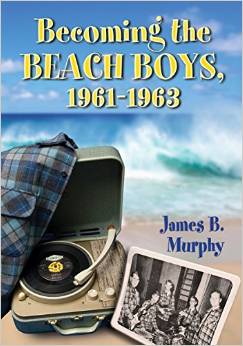
Murphy’s work is particularly necessary since The Beach Boys story stars so many unreliable narrators intent on telling the most self-serving versions of the tale (Murry, for example) or suffering patchy memories (Brian). The relatively minor players fascinate Murphy too, so we get extended bios of the band’s associates and collaborators during this period. Admittedly, the information digging can get a bit excessive, and only serious Beach Boys scholars won’t skim Murphy’s minutia about the guys who started Candix records or serial numbers on record labels or the dimensions of the handbills used to promote concerts. Consequently, Becoming the Beach Boys is not always a fun read, but it is an important historical document through and through. James B. Murphy definitely possesses the attention to detail I want from the dude who’s either writing a book about my favorite American band or diagnosing why my cat keeps throwing up all over the place.


Monday, June 29, 2015
Link to review: http://psychobabble200.blogspot.com/2015_06_01_archive.html